
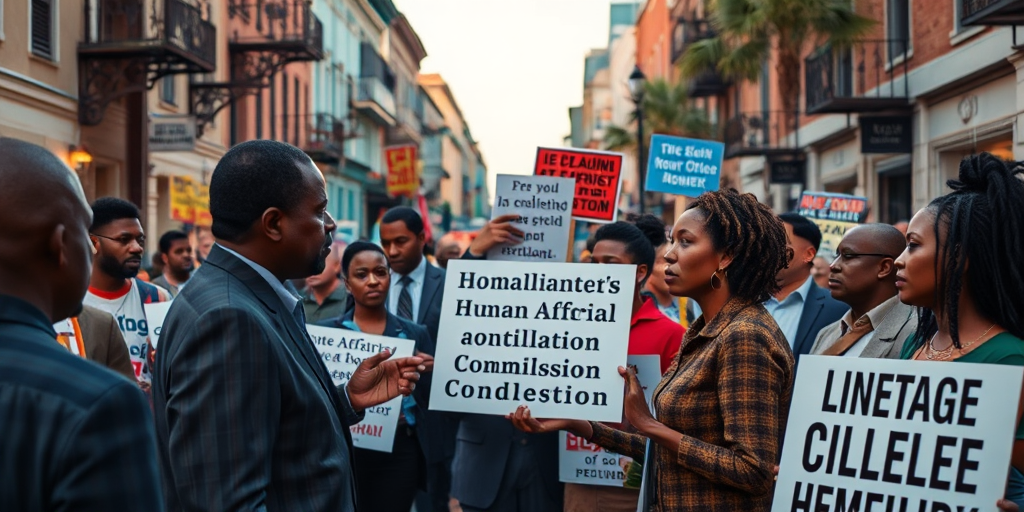
**Charleston’s Human Affairs and Racial Conciliation Commission Faces Critical Junction Amid Federal Pressure**
The Charleston Human Affairs and Racial Conciliation Commission (HARCC), a pivotal institution established in the aftermath of the Mother Emanuel shootings, is facing a defining moment that threatens its very existence. Having long served as a beacon for addressing systemic inequities in Charleston, HARCC’s future is now under scrutiny due to increasing federal pressures that place over $100 million in funding at risk. The commission, which has worked tirelessly for racial equity and reconciliation, now has only 13 days to devise a path forward.
**A History of Advocacy and Change**
HARCC was conceived as a response to the tragic 2015 shooting at Mother Emanuel AME Church, which served as a stark reminder of racial tensions in Charleston and beyond. Over the years, this commission has become a cornerstone in efforts to eliminate discrimination in housing, education, healthcare, and public safety across the city. With over 125 detailed recommendations, HARCC provides a comprehensive framework intended to secure long-lasting equity for all residents, irrespective of their race, gender, or socioeconomic status.
Councilmember William Gregorie, a foundational figure in HARCC’s establishment, emphasizes the significance of the commission maintaining its independence to truthfully represent Charleston’s diverse community. “It’s crucial that HARCC remains unencumbered by political forces,” Gregorie stated, “so it can continue its mandate of having all voices—whether white, Black, disabled, gay, or straight—that are vital to our society, heard and respected.”
**Federal Scrutiny and the Threat to Funding**
The immediate threat to HARCC stems from increased federal scrutiny over diversity, equity, and inclusion (DEI) programs, an aspect of federal policy making that has seen mounting challenges and criticism at various levels of government. The potential for these pressures to lead to the commission losing more than $100 million in funding casts a long shadow over its ongoing initiatives.
This scenario has compelled HARCC’s leadership and city officials to contemplate a significant shift, considering reincarnation as an independent nonprofit organization. This transition would provide a new operational model free from direct federal oversight, thus preserving the commission’s mission without current funding constraints.
**Community Impact: A Critical Juncture**
The potential dissolution of HARCC represents a pivotal moment for Charleston’s residents. For decades, HARCC has not only influenced policy decisions but has been instrumental in moderating grassroots efforts for sustainable community change. Its possible closure obliges civic leaders to reflect on alternative avenues to continue this pivotal work.
Local residents, deeply rooted in their community experiences, express concern over losing such vital support. John Daniels, a community leader, attested, “The work of HARCC has brought substantive change and awareness to our city’s disparities. Losing it could mean stalling progress, and that’s a risk we can’t afford.”
**Learning from the Past, Paving the Future**
Charleston’s struggle with equity and inclusion isn’t new. From historical segregation to modern-day inequities, the challenges have manifested in various forms over the years. The establishment of HARCC was lauded as a progressive step, yet the potential rollback signals a complex future that necessitates renewed dedication from local stakeholders.
This moment reiterates the need for strategic planning and active participation from all city demographics in searching for innovative solutions to these pressing issues. As city leaders search for alternatives to sustain HARCC’s influence, the broader implication on Charleston’s approach to systemic racism is undeniable.
**Balancing Perspectives**
As conversations around federal oversight and DEI programs take center stage, multiple perspectives have emerged. While some argue that the proposed changes decentralize initiatives better suited to local governance, others caution against a loss of resources and regulatory checks meant to ensure equitable practices.
Despite this tension, key stakeholders and community members share a unified aim: preserving Charleston’s commitment to racial justice and equal opportunity.
**Taking Action: Community Involvement and Resources**
City officials are encouraging community dialogue to explore every possible avenue for the commission. Public forums and discussions are planned in upcoming weeks to gather community input and advice on sustaining HARCC’s pivotal agenda.
Additionally, Charleston residents seeking more information or wanting to express ideas can reach out directly to Councilmember William Gregorie or attend scheduled city town hall meetings. The Charleston city website also provides updated information on the status of HARCC and upcoming plans for its continuity.
**Looking Forward**
Ultimately, the trajectory of Charleston’s Human Affairs and Racial Conciliation Commission will undeniably influence how other communities approach similar challenges. HARCC’s leadership and Charleston’s residents now face a test of unity and resilience that can either showcase pioneering adaptation or bear the penalties of a hindering misstep as they work towards continual progress and equity. As the clock ticks, Charleston stands at the crossroads of its future.


