
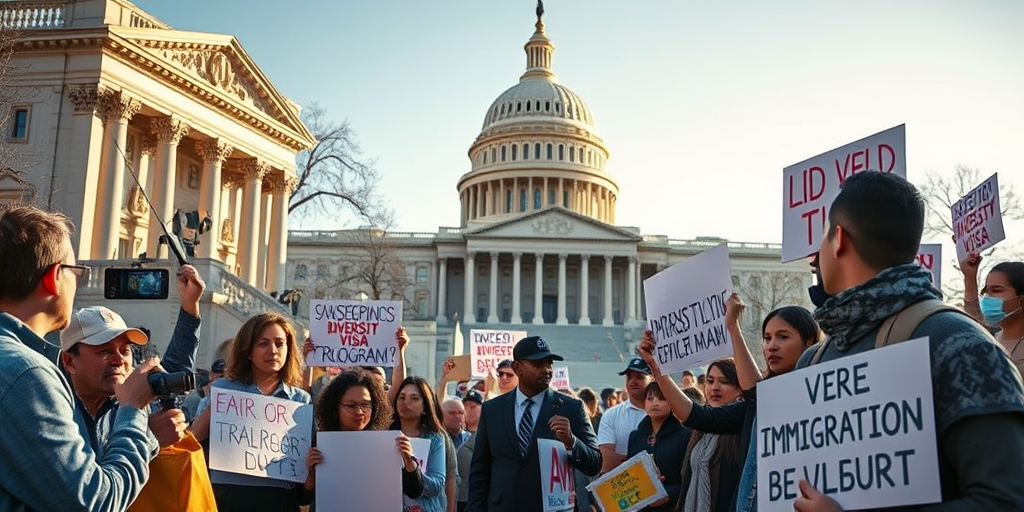
Diversity Visa Program Suspension Raises Uncertainty Following Brown Shooting Incident
In a controversial move, the Trump administration has announced the suspension of the Diversity Visa Program, a decision that could leave approximately 50,000 annual applicants in a state of uncertainty. This decision follows a tragic shooting incident involving Claudio Neves Valente, a Portuguese national who had previously obtained a diversity visa. The suspension of the program has sparked a broader debate about immigration and its impact on safety in the United States.
Background and Immediate Implications
The shooting incident at Brown University, which left two students dead and nine injured, along with the death of an MIT professor, has acted as a catalyst for the program’s suspension. Valente, who was found dead from a self-inflicted gunshot wound during a subsequent manhunt, was a recipient of the diversity visa, raising questions about the vetting process.
Initially established by Congress in 1990, the Diversity Visa Program was designed to increase immigrant diversity by allocating visas to individuals from countries with historically low rates of immigration to the U.S. It employs a lottery system that selects a limited number of applicants to become permanent residents, known as green card holders.
“This suspension thrusts thousands of applicants into a limbo, uncertain if their visa processing will continue or if their hopes of immigrating to the U.S. will be dashed,” said Elizabeth Shaw, a local immigration attorney. The exact number of Massachusetts residents affected is unknown, but the national impact is expected to be significant.
Community Impact and Concern
The repercussions of this decision are expected to ripple through immigrant communities across the U.S., where the diversity visa is often considered a crucial pathway to lawful permanent residency. Critics strongly argue that the administration is capitalizing on a tragedy to further anti-immigration policy.
David Keller, an attorney from Worcester, emphasized that the tragedy should not be used to blanket innocent applicants with suspicion. “The diversity program did not cause this tragedy, and its suspension would not have prevented it,” Keller stated. “The administration is using fear to promote its immigration policies, instead of focusing on meaningful reform.”
Furthermore, Annelise Araujo, a Massachusetts-based immigration attorney, highlighted the broader pattern of mass shootings. “Mass shootings are a grim reality in America, largely perpetrated by non-immigrants. Targeting the diversity visa program diverts focus from addressing deeper societal issues,” Araujo emphasized.
Procedural and Legal Considerations
The program selection entails a rigorous vetting process involving extensive background checks, including criminal history review and personal interviews, before visas are granted. Those selected must submit detailed documentation and undergo interviews at U.S. consulates, a process designed to ensure applicants pose no security threat.
A key point of contention now lies in the government’s lack of clarity regarding the suspension’s scope. It remains uncertain whether this halt pertains solely to future rounds of the lottery or also affects those already selected for visas. Immigration advocates are poised to mount legal challenges, considering the substantial impact on both current and future applicants.
“The lack of transparency is troubling. Families who thought they had secured entry find themselves caught in unsettling uncertainty,” stated Shaw. “We are exploring legal actions to restore opportunities for already vetted applicants.”
Moving Forward in a Polarized Climate
The decision to suspend the Diversity Visa Program has reignited discussions about immigration’s role in American society. Many see this as a broader pattern of policy-making increasingly influenced by fear rather than empirical evidence or public policy interests.
Within immigrant groups, the fear of being vilified for acts they had no part in is tangible. The narrative that immigrants pose an inherent risk is not only detrimental to social cohesion but undermines America’s historical commitment to diversity.
Moreover, the suspension draws parallel lines to past efforts by the Trump administration to curtail the program, following a previous attack by another diversity visa recipient in 2017.
Resources and Community Support
Local resources, such as community forums and legal aid workshops, are being organized to support those affected by the program’s sudden halt. Residents and hopeful applicants are encouraged to engage with community-based organizations to navigate this challenging period and to seek legal advice to explore potential pathways forward.
Ultimately, the suspension of the Diversity Visa Program challenges the very essence of America’s identity as a melting pot of cultures and ideas. As the nation grapples with this decision, efforts to address immigration policy and gun violence must be undertaken prudently, addressing core issues without compromising the country’s commitment to inclusivity and opportunity.


