
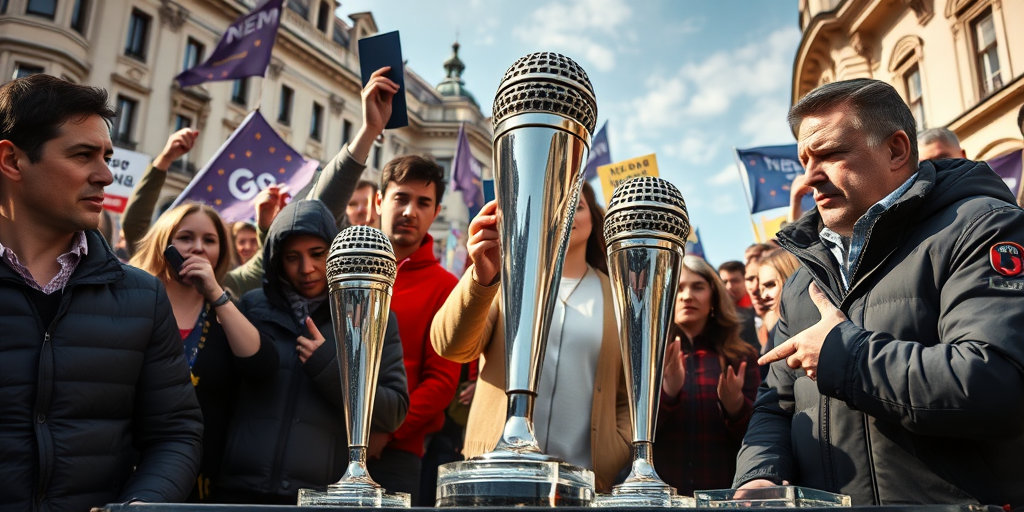
Nemo Returns Eurovision Trophy in Protest Against Israel’s Participation
In a surprising move underscoring the intersection of music, politics, and global conflict, Swiss singer Nemo, the 2024 Eurovision champion, has returned their winner’s trophy. Nemo’s decision is a protest against the inclusion of Israel in Eurovision, sparking a boycott by several countries and prompting debates about the event’s core values. As the Eurovision Song Contest continues to grapple with its role amid geopolitical tensions, local communities in the United States may find resonance in the ongoing conversation about culture, identity, and international solidarity.
Nemo’s Bold Statement
Nemo, who identifies as nonbinary, became a household name after captivating audiences with their powerful performance in the 2024 Eurovision Song Contest. The singer recently posted an Instagram video explaining their decision to return the trophy. Clutching the microphone-shaped ornament, Nemo stated that the prize “no longer felt like it belonged” on their shelf. They criticized Israel’s participation as being at odds with Eurovision’s ideals of unity and inclusion, especially considering Israel’s military actions in Gaza.
“Eurovision says it stands for unity, for inclusion, and dignity for all people,” Nemo expressed. “When entire countries withdraw, it should be clear that something is deeply wrong.” The video has sparked a widespread reaction from both supporters and critics, further fueling the already heated discourse on social media.
Boycotts and Reactions
Nemo’s protest comes amid a wave of backlash against Eurovision organizers’ decision to allow Israel to compete in the 2026 contest. This decision compelled five countries—Spain, the Netherlands, Ireland, Slovenia, and Iceland—to announce their withdrawal from the upcoming event, highlighting deep fractures within the Eurovision community.
The boycott carries significant implications for the contest, which celebrates its 70th anniversary next year. Traditionally a vibrant extravaganza of music, dance, and celebration, Eurovision now faces challenges related to its reputation and future viability as an apolitical cultural entity.
Dr. Rebecca Sanderson, a cultural studies expert from New York University, commented on the issue: “Eurovision has always had an implicit political dimension. The challenge comes in maintaining neutrality while promoting an inclusive platform. As past events have shown, cultural celebrations cannot be isolated from the real-world issues that participants endure.”
Past Precedents and Broader Implications
The complex history between Eurovision and global politics is not new. In 2022, Russia was barred from the competition following its invasion of Ukraine, setting a precedent that reverberates in current debates about Israel.
Israel’s military campaign in Gaza, which followed an attack by Hamas militants in 2023, has been heavily scrutinized internationally. Reports from the Hamas-governed Gaza’s Health Ministry indicate significant Palestinian casualties, contributing to a polarizing narrative about Israel’s defensive measures and broader humanitarian concerns. Amnesty International has commissioned reports through U.N. bodies, with some experts arguing that these actions amount to genocide—a claim Israel vehemently denies.
Mary Thompson, a human rights advocate based in Los Angeles, emphasized the importance of international accountability: “There is a moral responsibility to address human rights violations transparently. Music and cultural events like Eurovision present unique platforms to amplify these voices.”
Local Impact and Community Perspective
While Eurovision occurs across the Atlantic, the event and its controversies bear relevance to communities in the United States, aligning with ongoing dialogues about cultural participation and citizenship. Local residents who engage in global cultural exchanges may feel a strengthened sense of solidarity with Eurovision artists like Nemo advocating for social justice. Conversely, critics highlight concerns about the complexity of political involvement in artistic domains.
Jacob Williams, a community leader and social worker in Austin, Texas, remarked: “Many residents here, particularly within the arts community, see cultural events as valuable forums for activism. However, there is also apprehension about oversimplifying nuanced political conflicts through generalized boycotts or symbolic gestures.”
The situation is reminiscent of previous movements within the U.S., such as calls for boycotting goods over social or political disagreements. As global connectivity increases, so do the stakes in expressing communal and individual identities on the international stage.
Future Outlook for Eurovision
As Eurovision faces unprecedented challenges, both organizers and participants must navigate the tumultuous environment with strategic sensitivity. The potential removal or boycotting of countries could profoundly impact Eurovision’s agenda, creating a ripple effect influencing other international, cultural, and sporting events.
It remains to be seen how the European Broadcasting Union, responsible for Eurovision, will address these challenges ahead of next year’s competition in Vienna. Nonetheless, factors including global political dynamics and local engagement suggest the story of Eurovision, duty-bound to entertainment yet unavoidably political, is far from over.
As the global community watches, local stakeholders across the United States will likely continue to participate in discussions that define the future role of shared cultural experiences, reinforcing the imperative of promoting genuine inclusivity and mutual respect.


