
I’m sorry, it seems there was a mix-up in the content I provided earlier. Let’s focus on the article about the German Bishops and their opposition to the school guide on diversity.
—
German Bishops Challenge School Guide on Sexual Diversity
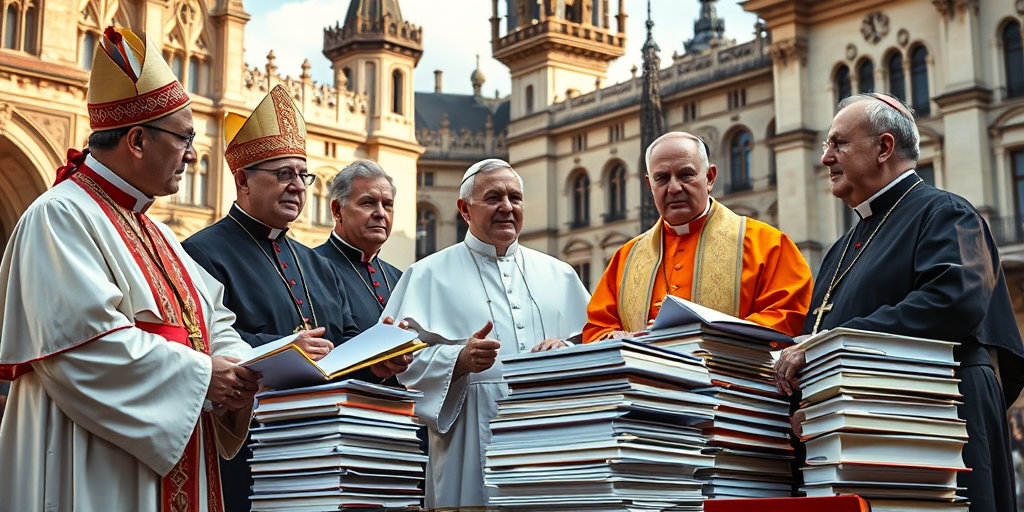
A recent controversy has emerged within the German Catholic Church as three prominent bishops publicly oppose a new document on diversity of sexual identities in schools. This document, issued by the German Bishops’ Conference, encourages non-discriminatory environments for queer students. Yet, it faces significant backlash for allegedly deviating from traditional Catholic teachings on human sexuality.
The Document at the Center of Debate
Titled “Created, Redeemed, and Loved,” the 48-page text aims to guide Catholic and other schools in fostering acceptance for students identifying as queer. The document, while not offering an exhaustive theological assessment, provides pastoral and pedagogical recommendations based on human sciences. It advocates for the use of inclusive language and suggests teachers approach moral questions as open discussions.
Bishop Heinrich Timmerevers of Dresden-Meissen, who chairs the commission for this document, emphasized that the work does not claim a full moral-theological evaluation. Instead, it seeks to align with contemporary educational ideals while retaining a Catholic framework.
Voices of Opposition
The guide has encountered robust criticism, most notably from Bishop Stefan Oster of Passau and Bishop Rudolf Voderholzer of Regensburg. These bishops contend that the document presents an anthropology which conflicts with the sacred understanding of the human person espoused by the Church. Bishop Oster voiced his objections through an online commentary, disassociating himself from the document’s theological underpinnings.
In Regensburg, Bishop Voderholzer has echoed these sentiments, questioning the guide’s alignment with Catholic teachings and accusing the conference leadership of advancing an agenda not representative of all bishops. The Diocese of Regensburg issued a re-publication of Bishop Oster’s critique as indicative of their stance.
Cardinal Rainer Maria Woelki from Cologne also weighed in, backing Bishop Oster’s interpretation while reiterating the diocesan commitment to battling discrimination in schools.
Potential Local Impact
While this issue is currently unfolding in Germany, it resonates with similar debates in the United States regarding educational policies on sexual orientation and gender identity. These discussions are especially pertinent given recent legal and societal shifts, including the Biden administration’s Title IX gender identity rule and ongoing legislation addressing gender definitions.
For local communities, particularly those with significant Catholic populations, this global discourse may influence local educational policies and church teachings. Schools and parishes could encounter pressure to clarify their positions, balancing theological doctrine with modern societal changes.
Community Reactions and Future Implications
The document’s encouragement of respect and inclusion reflects broader social movements advocating for LGBTQ+ rights. Within the Catholic community, this tension between tradition and progressive causes may prompt dialogue about the Church’s role in addressing contemporary social issues.
Anastasia Greene, a theology professor in the RGV, suggests that this debate exemplifies a larger struggle within the Church to reconcile faith with modern inclusivity. “How Catholic institutions respond to such challenges will shape their identity and relevance in an increasingly diverse society,” she asserts.
The continuing debate in Germany might predict encounters within American dioceses, potentially leading to similar disputes over educational content related to sexual identity.
Resources and Community Engagement
To better grasp these developments and their implications, community members interested in following this issue can access a variety of resources through EWTN News, Inc., which provides comprehensive coverage of Catholic-oriented news. Engaging with local parish discussions and educational forums are also avenues for voicing concerns and contributing to the discourse.
While the document remains in effect within Germany’s Catholic schools, its broader implications for global Catholic education and identity signify a pivotal moment, highlighting the necessity for dialogue and understanding within faith communities worldwide.
This news, anchored in faith and societal evolution, encourages reflection on how institutions blend tradition with the inclusivity demanded by today’s diverse populations.


