
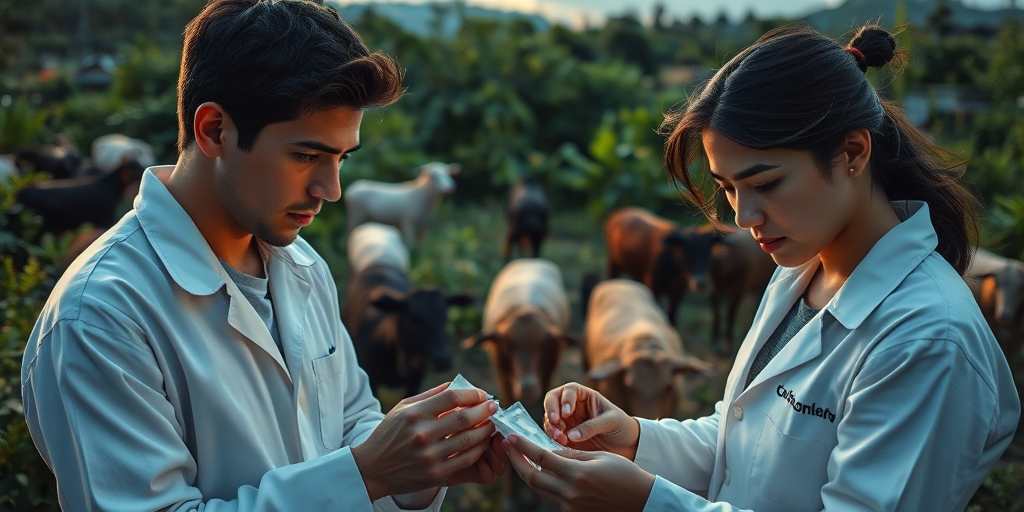
### Study Highlights Landscape Effects on Farm Animal Parasite Diversity Near Colombian Conservation Areas
In a groundbreaking study published in *Acta Parasitologica*, researchers from Colombia explore the significant relationship between landscape configuration and the diversity of gut parasites and fungi in farm animals situated near conservation areas. The findings, announced on November 25, 2025, bring to light the complex dynamics between agricultural landscapes, biodiversity, and epidemiological risks, emphasizing the need for strategic landscape management to protect both livestock and wildlife.
### Key Insights from the Research
The research capitalizes on the unique biodiversity of Colombian landscapes, serving as a natural laboratory to examine how landscape changes impact host-pathogen interactions. Utilizing high-resolution spatial data and parasitological surveys, the study reveals that fragmented landscapes with numerous small habitat patches heighten the diversity and transmission of parasites among farm animals. This underscores the epidemiological risk posed to wildlife by facilitating parasitic transmission through agricultural practices and habitat fragmentation.
Dr. Natalia Roncancio-Duque, a leading researcher on the project, stated, “Our study highlights the critical role landscape configuration plays in pathogen dynamics. These insights are pivotal for developing interventions that can mitigate the risk of zoonotic diseases originating from areas where farm animals and wildlife coexist.”
### Landscape Configuration: A Crucial Factor
The landscape configuration in question involves various spatial elements such as habitat fragmentation, connectivity, and patch size. The study’s hypothesis posits that these elements significantly influence the diversity and prevalence of parasites due to their effects on host distributions and pathogen transmission routes. Researchers employed advanced remote sensing and GIS technologies to meticulously map these landscape features, constructing models that elucidate the intricate relationship between landscape patterns and pathogen ecology.
One striking discovery from the research is the increased presence of gut parasites and fungi in farm animals residing in fragmented habitats. This suggests that the disruption of continuous landscapes increases interspecies encounters and facilitates a microclimate conducive to pathogen growth and transmission. This aligns with broader ecological theories suggesting that landscape heterogeneity can either hinder or exacerbate disease spread based on specific dynamics.
### Implications for the Local and Global Community
The insights from this study hold substantial conservation and public health implications. The proximity of farm animals with diverse parasites to protected wildlife habitats raises concerns about zoonotic spillover events. This poses a critical challenge for conservation efforts, particularly as Colombian conservation areas are home to several endangered species.
Dr. Javier Garcia-Ariza, another researcher involved in the study, emphasized, “We must look towards integrated landscape management that encompasses both agricultural productivity and wildlife conservation. This study provides the foundation for policies that could balance these needs, ensuring sustainable ecosystem health.”
For the local Colombian community, the findings advocate for strategies like enhancing habitat connectivity, managing edge habitats, or establishing buffer zones to decrease wildlife-livestock interfaces. Such measures are vital not only for preserving biodiversity but also for safeguarding agricultural interests by preventing livestock diseases, thus supporting local farmers’ livelihoods.
### Connection to Previous Local Initiatives
The urgency highlighted by the study reflects ongoing initiatives in Colombia to address habitat fragmentation and its impacts on ecosystems. Previous conservation projects have focused on reforestation and habitat restoration, while agricultural sectors have called for sustainable practices to ensure environmental and economic viability. The study reinforces these efforts by connecting ecological health with agricultural and public health outcomes, urging stakeholders to consider broader approaches that incorporate landscape complexity.
### Future Directions and Perspectives
Looking forward, the research suggests that monitoring gut parasite and fungal diversity in farm animals could act as an early warning system for emerging diseases. By systematically surveilling livestock in environmentally sensitive areas, changes in pathogen communities that pose threats to wildlife or humans can be promptly identified. This proactive approach is crucial within the context of global trends in biodiversity loss and climate change, which exacerbate the risks of zoonoses.
Moreover, the study invites further investigation into the role of fungi within the gut microbiomes of farm animals, a topic often overshadowed by bacterial studies. Understanding the ecological significance of these fungi could reveal new dimensions of pathogenesis and offer innovative solutions to veterinary challenges.
In conclusion, the research emphasizes that addressing the challenges at the wildlife-livestock interface necessitates embracing landscape complexity rather than simplifying ecological interactions. It calls for a collaborative framework among scientists, conservationists, policymakers, and the agricultural community to create solutions that harmonize landscape management with biodiversity conservation and disease control objectives.
### Community Engagement and Resources
For residents interested in how these findings impact local practices and preventative measures, Colombia’s Ministry of Environment and Sustainable Development will host public seminars and discussion forums. These events aim to disseminate knowledge, answer community questions, and forge partnerships for implementing the research’s recommendations.
Further information about the study can be accessed through Bioengineer.org, an online platform dedicated to spreading cutting-edge bioengineering research, ensuring the findings reach a broader audience and spark meaningful dialogue across diverse communities.
As the global community navigates the intersections of environmental health, agricultural sustainability, and emerging diseases, studies like this serve as a beacon of informed research, pushing for strategies that secure a balanced coexistence between human, animal, and ecological health.


