
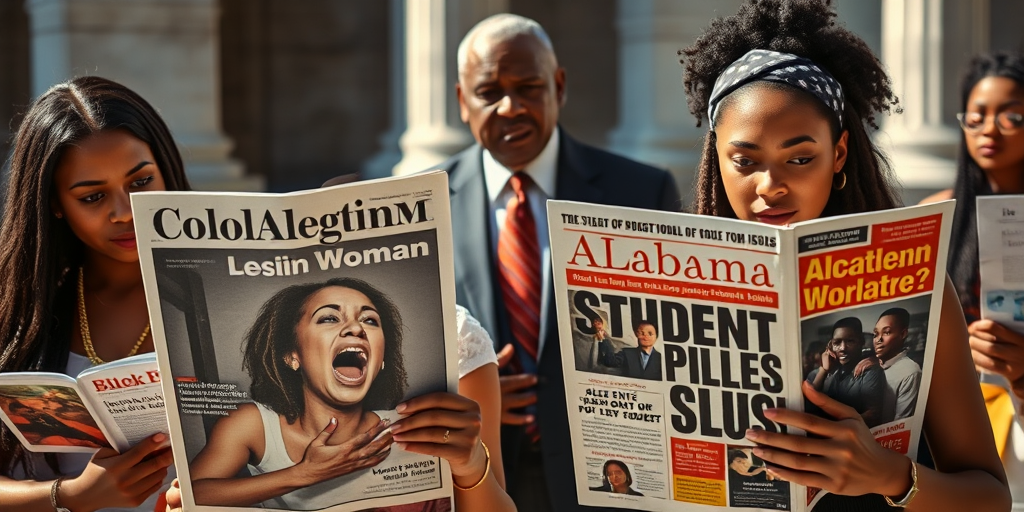
**Trump’s Anti-Diversity Measures: Student Publications in Alabama Face Shutdown**
The University of Alabama has become the center of a heated debate following its recent announcement to shut down two student-run publications, Alice and Nineteen Fifty-Six, in compliance with anti-diversity measures set by the Trump administration. The move has sparked concerns over freedom of speech and the impact on campus culture.
**Immediate Impact: Shutting Down Student Voices**
Alice, a publication addressing women’s issues, and Nineteen Fifty-Six, focused on Black student experiences, have been indefinitely closed. Nineteen Fifty-Six holds historical significance, being named to honor Autherine Lucy Foster, the university’s first Black student in 1956. This decision has left student communities bewildered and uncertain.
“This feels like a direct violation of our freedom of speech,” Leslie Klein, the managing editor of Alice, expressed. The disbelief is echoed by Kendal Wright, Nineteen Fifty-Six’s editor-in-chief, who criticized the university’s decision amidst the national political climate, yet found it unsurprising.
**Political Context: Anti-DEI Measures**
The university’s justification hinges on a memo from U.S. Attorney General Pamela Bondi, suggesting Diversity, Equity, and Inclusion (DEI) programs might breach federal anti-discrimination laws. These measures have been a focal point of the Trump administration, targeting what they consider discriminatory practices disguised as inclusivity efforts.
Alex House, spokesman for the University of Alabama, affirms compliance with legal obligations, ensuring “all members of our community feel welcome.” However, student editors argue against any discrimination within their content and welcome participation from all demographics.
**Local Reaction: Outrage and Advocacy**
The Foundation for Individual Rights in Education (FIRE) has condemned the university’s actions as an attack on student press freedoms, calling for the reinstatement of the publications. “This is an attack on the student press, plain and simple,” commented Marie McMullan, FIRE’s student press counsel.
Community reaction is heavily marked by concern for student expression and campus diversity. Gabrielle Gunter, editor-in-chief of the now-shuttered Alice, described the move as “dumbfounding,” further emphasizing the publication’s role in celebrating its 10-year anniversary focused on providing an inclusive platform for women’s voices.
**Historical and Ongoing Issues**
This closure is not an isolated incident within Trump’s administration. Previously, similar actions affected the Black Student Union and LGBTQ+ centers on campus, removing spaces intended for support and community building. Nationally, several universities, including Harvard, have faced funding threats tied to DEI programs.
This trend aligns with rhetoric from Canadian political figures, notably Conservative Leader Pierre Poilievre, who has echoed sentiments against “woke ideology” in educational funding amid their electoral campaigns, prompting comparisons with U.S. policies.
**Long-term Implications for the Community**
Looking forward, the university plans to introduce a new publication with a broader scope to replace Alice and Nineteen Fifty-Six. However, current staff members aim to relaunch their magazines independently, reinforcing their commitment to maintaining dedicated voices for gender and racial issues.
“It’s a really important thing for our voices to be heard,” Leslie Klein emphasized, highlighting the group’s determination to continue their work outside university support.
Locally, this decision can profoundly affect community engagement, contributing to a shift in how diversity and inclusivity are fostered at educational institutions. It raises questions about institutional support for marginalized groups and the boundaries of freedom of expression within academic settings.
**Moving Forward: Community Engagement and Support**
As the dust settles, residents and stakeholders within the community are encouraged to join public forums and discussions to voice their concerns and support the reestablishment of the publications. Engagement can provide crucial insight and ensure the university remains a place where diverse voices contribute to broader educational and societal discourse.
This development serves as a reminder of the delicate balance between governmental policies and educational freedom, emphasizing the need for continued advocacy to protect student expression and minority representation within academic institutions across the United States.


