
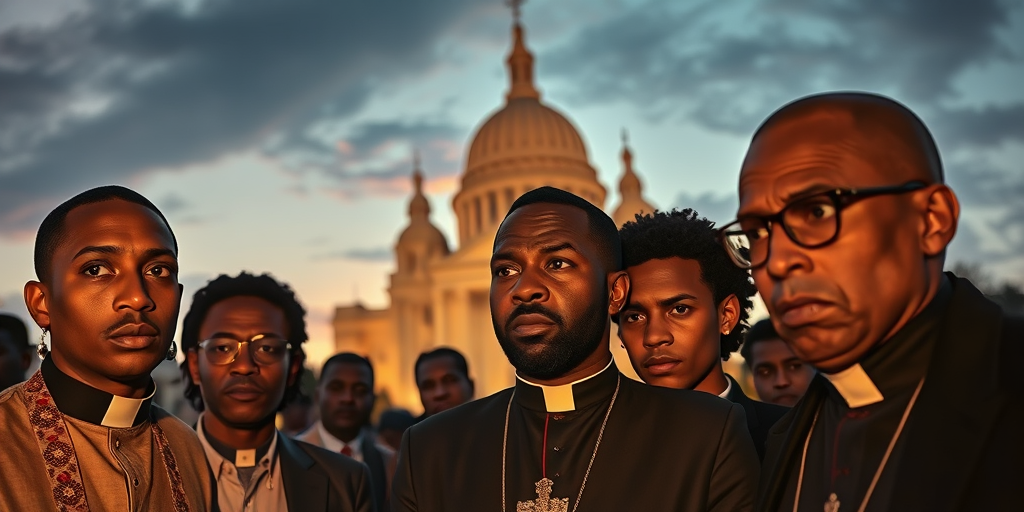
Headline: “Unmasking Systemic Racism: The Struggles of Black Catholics in Urban America”
A Hidden Legacy: Systemic Racism in the Urban Catholic Church
In a revealing piece of scholarship, Tia Noelle Pratt’s “The Numbers Don’t Add Up: Systemic Racism and Its Legacy in Urban Catholic Life” highlights the deeply-entrenched systemic racism in the Catholic Church, particularly impacting African American Catholics. While racism is often thought of in terms of interactions between individuals, systemic racism operates within larger structures, affecting practices surrounding liturgy, church reorganization, and parish closures, generating significant consequences for the African American Catholic community.
Even as the U.S. Catholic Church claims a membership of 72.4 million, only 3 million of those are Black Catholic, a statistic that underscores the disproportionate representation of Black Catholics—a discrepancy rooted in systemic racism. This issue is not just of national concern but has deep resonance at the local level, as reported by Woke News.
Local Context and Impact
Across many urban centers in the United States, Black Catholics experience systemic barriers that hinder their full participation in church life. This phenomenon reverberates through communities in cities like Chicago, New York, Baltimore, and Philadelphia, where the history of Black Catholics remains underappreciated and misunderstood. Resident and longtime Catholic Marcia Thomas remarked, “It’s a story of invisible bonds and visible challenges. Our presence is often not acknowledged, yet our struggles within the church are very palpable.”
The roots of this lack of representation stretch back to the importation of Catholicism by European settlers, whose orthodoxy was upheld by national parishes. These parishes focused heavily on preserving the cultural ties of European immigrants—primarily Germans, Irish, and Italians—allowing them to maintain cultural continuity while assimilating into American society. Meanwhile, Black Catholics found themselves marginalized, their identity and contributions overshadowed by the dominant Euro-centric narrative.
Voices from the Community
Delving into the past, the Catholic Church’s role in slaveholding compounds the issue. Institutions such as Georgetown University owe their financial stability during formative years to profits derived from slave labor. This historic injustice continues to ripple through the lives of descendants today. Reverend Timothy Branston of St. Augustine’s Parish in Washington D.C. notes, “The link between the church’s historic complicity in slavery and present-day challenges for Black Catholics cannot be understated. It’s a legacy we are still navigating.”
Previous Reports and Current Conversations
Within urban settings, stories of unacknowledged Black Catholic identities persist. Local parishes report feeling isolated, culturally alienated, and systematically sidelined compared to their European counterparts, who historically benefited from social mobility driven by church-supported programs. As resident and activist Janelle Harris points out, “Our parishes are a testament to both endurance and exclusion. Time after time, we have advocated for recognition and resources, only to be dismissed as subsidiary in importance.”
The local Catholic Church faces intense scrutiny as it shadows previous reports of systemic inequities and racial biases. Historically, the church’s strategic closing of predominantly Black parishes raises questions about institutional priorities. These closures have frequently dismantled community structures integral to Black cultural and spiritual life, leading to stark demographic imbalances. Archbishop Michael Lee from the San Francisco Archdiocese recently sparked hope by announcing a task force dedicated to improving inclusivity within parish programs. However, critics argue that more substantive structural change is needed to address deep-seated inequalities woven into the societal fabric.
Future Implications and Resources
Wider implications of this report challenge church leaders and members to confront the uncomfortable truths surrounding systemic racism in church institutions. Debate continues on potential solutions, calling the community to active participation in reshaping policies towards a more inclusive future. Engaging local parishioners and clergy in open dialogue is crucial, encouraging accountability from church leadership.
For residents seeking more information or wishing to involve themselves in change initiatives, several resources are available. The National Black Catholic Congress offers outreach programs and workshops focused on education and advocacy. Additionally, local parishes such as St. Martin de Porres offer platforms for community discussions about systemic racism’s impact.
Ultimately, Tia Noelle Pratt’s insightful analysis encourages introspection within the Catholic Church. It serves as a crucial step towards an honest reckoning with history, igniting collective action to dismantle barriers and foster true inclusivity for Black Catholics. As the church navigates its own legacy of racial injustice, it is essential that efforts to address these inequalities are conceived through collaborative, community-focused solutions.


